“Our software is broken and our last dev team can't ship”
Two Years of a Broken Build, Then a Working Engine in One Month
Took over a stalled legal-tech platform and rebuilt its reconciliation engine on a dual-agent design, after proving the approach on the client's own documents over a single weekend.
“They've had two years. I've got customers on this thing today.”
Who they are
A legal-tech platform serving family-law firms. Its product reconciles bank statements against the financial affidavits filed in divorce proceedings — slow, adversarial work where a missed transaction is not a rounding error but a disputed fact.
The company already had paying customers on the product when we met them.
What was going wrong
A previous development team had spent two years on the reconciliation engine — the actual core of the product — without shipping something reliable. What existed carried known security vulnerabilities, screens that loaded out of order, and raw error codes surfacing to end users.
Meanwhile the client’s own power user was still reconciling each case by hand, a process that took roughly six weeks. The product that was supposed to eliminate that work had not yet replaced any of it.
The founder’s position was simple. Two years of a vendor’s promises counted for nothing against the customers already depending on the product.
What we built
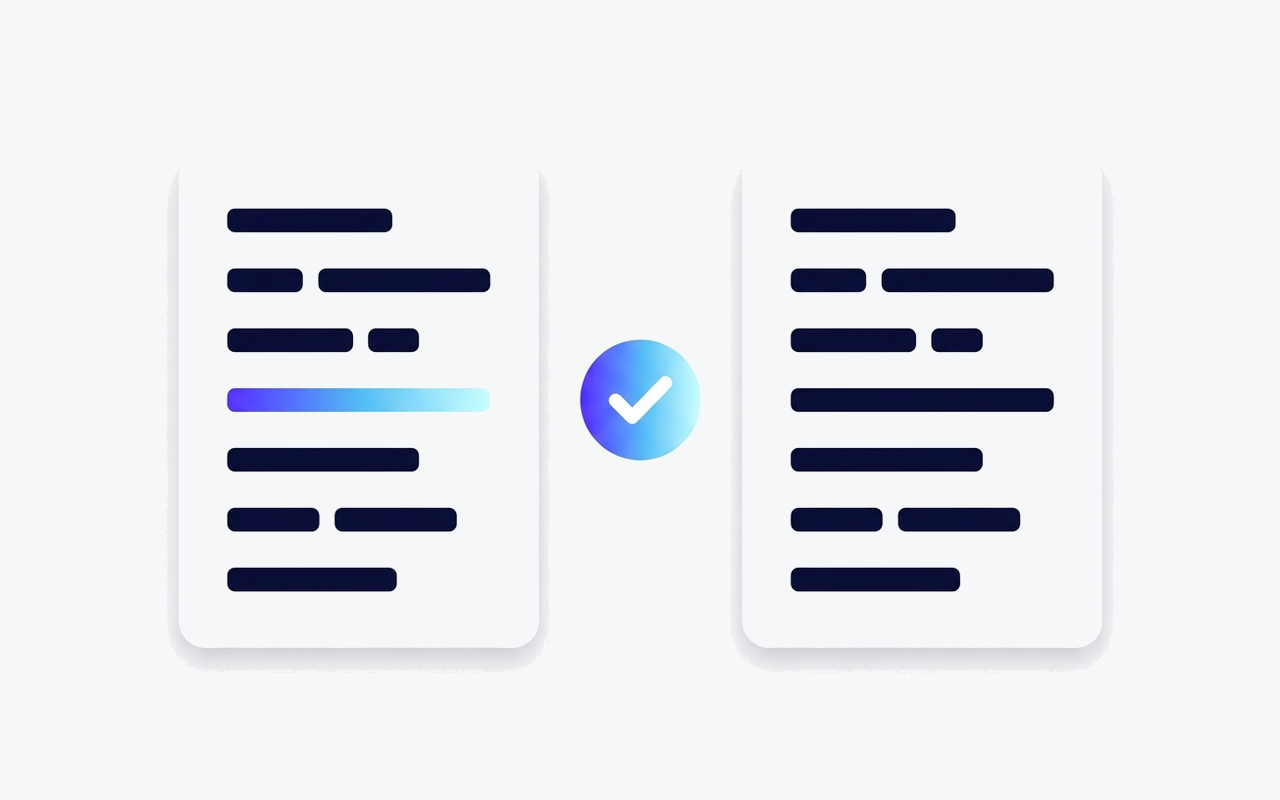
Before any contract existed, we built a working proof of concept on the client’s own documents over a single weekend. It reconciled 6 of 6 statements to the cent and surfaced 521 transactions where their live product found 516.
We then took over the codebase along with the AWS, Cloudflare, MongoDB Atlas and Vercel environments — inheriting a year of undocumented decisions in the process — and rebuilt the reconciliation engine on a dual-agent design. Two independent AI agents check every result. Anything they disagree on, flag as low-confidence, or simply cannot read is routed to a human rather than guessed at.
In parallel we proved a cheaper model against the same validation set before switching to it, so the cost reduction was demonstrated rather than assumed.
What happened
The weekend proof of concept replaced the product walkthrough entirely, and closed the engagement on its own.
One month after kickoff the rebuilt engine was live in staging at 96% agreement across every validation case. The dual-agent design is engineered to cut the AI cost of a typical multi-statement case from about $300 to $10-15, an estimated reduction of over 95%. A further $500 a month came out of cloud spend during the cleanup.
Throughout the takeover and rebuild, the platform kept running for its paying customers. The client is now recruiting outside testers for a structured UAT phase ahead of a wider release.